

Types Of Symmetry In Graphs
Symmetry and Graphs
Symmetry is more of a geometrical than an algebraic concept but, equally mentioned in the previous 2 pages, the subject area of symmetry does come up in a couple of algebraic contexts. When y'all're graphing quadratics, you lot may be asked for the parabola'south centrality of symmetry. This is usually merely the vertical line x = h , where "h" is the ten -coordinate of the vertex, (h, k). That is, a parabola's axis of symmetry is usually simply the vertical line through its vertex. The other customary context for symmetry is judging from a graph whether a function is fifty-fifty or odd.
Notation: By definition, no role tin can exist symmetric about the x -axis (or any other horizontal line), since anything that is mirrored around a horizontal line will violate the Vertical Line Test.
On the other hand, a function can be symmetric about a vertical line or about a point. In particular, a function that is symmetric almost the y -axis is as well an "even" function, and a function that is symmetric near the origin is also an "odd" role. Because of this correspondence between the symmetry of the graph and the evenness or oddness of the function, "symmetry" in algebra is ordinarily going to apply to the y -axis and to the origin.
-
In what follows, list any symmetries, if whatsoever, for the displayed graph, and state whether the graph shows a function.
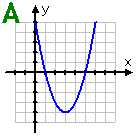
Graph A: This graph is symmetric near its centrality; that is, it is symmetric about the line ten = 3 . There is no other symmetry. This graph shows a role.
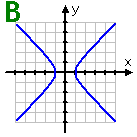
Graph B: This graph is symmetric about the axes; that is, it is symmetric near the lines x = 0 (the y -centrality) and y = 0 (the x -axis). It is also symmetric about the origin. Since there exist vertical lines (such as the line x = ii) which will cross this graph twice, what it shows is not a function.
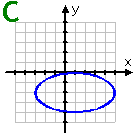
Graph C: This graph is symmetric about the lines 10 = 1 and y = −ii , and symmetric nearly the betoken (ane, −2) . Since a vertical line can be drawn to cross the ellipse twice, this is not a function.
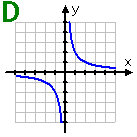
Graph D: This graph is symmetric well-nigh slanty lines: y = x and y = −x . It is also symmetric about the origin. Considering this hyperbola is angled correctly (so that no vertical line tin cross the graph more than once), the graph shows a role.
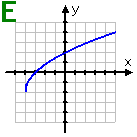
Graph E: This graph (of a foursquare-root function) shows no symmetry whatsoever, but it is a function.
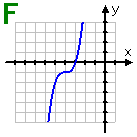
Graph F: This graph (of a cubic function) is symmetric near the betoken (−4, −i) , simply not around any lines. This graph does testify a function.
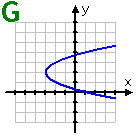
Graph One thousand: This parabola is lying on its side. It is symmetric most the line y = two . It is not a function.
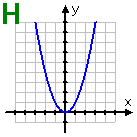
Graph H: This parabola is vertical, and is symmetric about the y -axis. It is a function; in fact, it is an even function.
-
In what follows, determine from the graphs whether the displayed functions are even, odd, or neither.
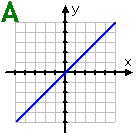
Graph A: This linear graph goes through the origin. If I rotate the graph 180° around the origin, I'll get the aforementioned picture. And so this graph is odd. (The function would not be odd if this line didn't get through the origin.)
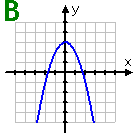
Graph B: This parabola's vertex is on the y -axis, so the axis of symmetry is the y -axis. That means that the function is even.
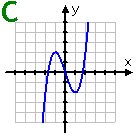
Graph C: This cubic is centered on the origin. If I rotate the graph 180° around the origin, I'll get the same motion picture. So this graph is odd.
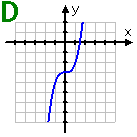
Graph D: This cubic is centered at the point (0, −3). This graph is symmetric, but non about the origin or the y -centrality. And then this function is neither even nor odd.
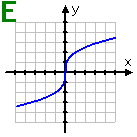
Graph E: This cube root is centered on the origin, so this role is odd.
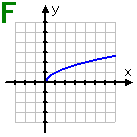
Graph F: This foursquare root has no symmetry. The function is neither even nor odd.
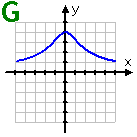
Graph G: This graph looks like a bell-shaped curve. Since it is mirrored around the y -axis, the function is even.
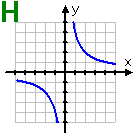
Graph H: This hyperbola is symmetric about the lines y = ten and y = −x , but this tells me nothing about evenness or oddness. However, the graph is also symmetric about the origin, so this function is odd.
When looking for symmetry, you don't have to merely sit at that place trying the puzzle the thing out in your caput. Instead, have the paper and your pencil, and see if there is a spot where you lot can plant the pencil's eraser, and then spin the paper on the table. When it's spun halfway effectually, do you get the same motion-picture show as you had before? And then your eraser marks a point of symmetry. Grab a ruler and stand up information technology on its edge in the middle of the graph. Look down onto the paper, and centre-brawl the 2 "sides" of the flick. Practise the two portions of the graph, ane on either side of the ruler, look like mirror images? And so the ruler marks a line of symmetry. Don't be shy about putting your hands into the piece of work; it can actually assist in getting a "feel" for symmetry.

Types Of Symmetry In Graphs,
Source: https://www.purplemath.com/modules/symmetry3.htm
Posted by: brownhoweenton.blogspot.com
0 Response to "Types Of Symmetry In Graphs"
Post a Comment